
Why Compressor Mounting and Piping Support Matter During Replacement
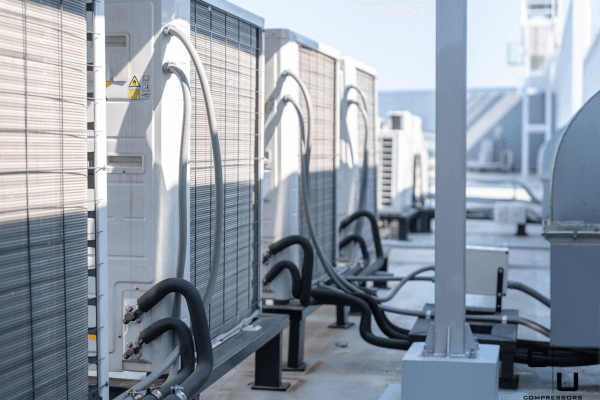
A correctly matched replacement compressor still needs a sound base, appropriate mounts, and properly supported piping. Learn what contractors and facility managers should check during commercial HVAC/R compressor replacement, from mounting rails and isolators to piping alignment and operating vibration, to help reduce mechanical stress and recurring connection leaks.
A replacement compressor can be correctly matched to the system but still inherit problems from the surrounding equipment. A damaged mounting rail, an incorrectly installed isolator, or a refrigerant line pulled into position can leave the installation under unnecessary mechanical stress. When the system starts, those problems may show up as noise, movement, or a connection that will not stay leak-free.
Evaluate compressor mounting and piping support together during replacement. The mounting arrangement must suit the compressor and equipment design, while the connected piping must accommodate the movement that design allows. For contractors and facility managers, this means looking beyond whether the replacement fits into the available space.
When selecting commercial HVAC/R compressors from Compressors Unlimited, include the physical installation in the replacement discussion. Matching the model is important, but the condition of the base and connected lines also deserves attention.
Understand What Is Moving Before Blaming the Compressor
Noise near a compressor doesn't automatically indicate an internal failure. The compressor body, equipment frame, and refrigerant piping can transmit movement differently. A line that shakes noticeably while the compressor remains relatively stable deserves a different investigation from a compressor that moves excessively on its mounting points.
Carlyle identifies several causes of refrigerant-line vibration, including structural resonance and vibration driven by compressor movement or discharge-gas pulsations. Resonance occurs when the piping responds strongly to an exciting frequency, amplifying its movement. This helps explain why changing a fitting or support can affect a line's behavior even when the compressor itself has not changed.
Before removal, document where the movement appears, when it occurs, and whether it changes during startup or normal operation. Photographs of the existing arrangement and a description of recurring leaks give the contractor useful context. Don't assume installing another compressor will fix a problem originating in the piping.
Inspect the Base Before Installing the Replacement
The replacement job provides an opportunity to inspect areas that are difficult to see with the compressor in place. Review the mounting rails, fastening points, and surrounding structure for corrosion, cracks, distortion, or evidence that components have shifted. Recommend repairing structural problems before they become part of the new installation.
A useful question is whether the base can support the compressor in the position the equipment manufacturer requires. If a mounting point sits unevenly, tightening the hardware should not replace correcting the underlying fit. Improvised spacers and altered rails also deserve review rather than automatic reuse.
Keep the mounting inspection in the job documentation. A simple photograph showing the repaired base and installed hardware can help the next technician understand what was changed. It also makes the replacement record more useful than a note that only says the compressor was installed.
Select the Mounting Arrangement for the Actual Application
No single mounting approach suits every commercial compressor installation. A rigid arrangement and a resilient arrangement affect how movement reaches the frame and piping. Follow the instructions for the compressor, mounting kit, and original equipment rather than selecting hardware solely because it appears quieter or easier to install.
Copeland's guidance on alternative compressor mounting explains that you must evaluate replacement mounting for vibration, noise, and movement. Copeland also cautions against the compressor foot laterally compressing the mount. That makes mounting selection an application decision, rather than a simple choice between old and new hardware.
Where shipping restraints or operating adjustments apply, identify them from the correct instructions before startup. Do not borrow spring settings, clearances, or bolt-tightening procedures from a different compressor family. Hardware that looks similar may serve a different purpose.
Check Piping Alignment Without Using the Compressor as a Brace
Treat a connection that requires substantial pulling or repositioning as a reason to investigate alignment. Recommend checking the compressor's installed position, service-valve orientation, and nearby supports before completing the connection. The goal is to establish the intended fit instead of relying on the assembled joint to hold the line in position.
Review the surrounding pipe run and the connection directly at the compressor. Include unsupported sections, contact with adjacent components, and the location of existing supports in the inspection. If alterations are needed, have the contractor evaluate them as part of the piping design, including requirements for refrigerant flow and oil return.
Adding supports or vibration absorbers without considering the whole arrangement can create another problem. Carlyle's vibration guidance explains that mounting and piping geometry interact, and that changes to an established design may require renewed evaluation. A piping modification should therefore be checked under operation rather than accepted simply because it fits.
Apply the Review to Specific Compressor Models
Compressors Unlimited lists the Carrier 06D*537 as a remanufactured semi-hermetic reciprocating compressor for commercial air conditioning. For an installation involving this listing, provide the complete existing nameplate information and confirm the supplied configuration before ordering. Include photographs of the mounting position and service connections so the physical arrangement can be reviewed alongside the application.
The Carrier 06E*299 is another listed remanufactured option for commercial air conditioning. Do not assume an installation detail from a 06D job applies unchanged to a 06E replacement. Carlyle's 06E product information shows that physical dimensions and weight vary across configurations, reinforcing the need to check the actual unit and equipment layout.
For commercial refrigeration, Compressors Unlimited lists the Copeland 4DJ3R28M, displayed in its catalog as 4DJ3R28M. Include the mounting assembly and connected piping in the review for this model as well. Confirm the complete electrical and application specifications, and have the contractor verify the required installation details.
These three listings illustrate different replacement discussions. They are not interchangeable recommendations, and a catalog listing does not replace application verification. Confirm current availability and the exact configuration with Compressors Unlimited before placing your order.
Observe the Installation Beyond the First Start
Build an operating review into the replacement plan. Recommend documenting the behavior of the compressor, base, and connected lines during startup and stable operation. Where the equipment has capacity stages, observe the relevant stages rather than treating one brief run as a complete evaluation.
Record unusual movement, repeated contact between components, and changes in sound for further investigation. If something appears abnormal, follow the equipment manufacturer's service procedures instead of repeatedly restarting the system to see whether it settles down. Operating observations should accompany the required leak checks and normal commissioning records.
For facility managers, ask the contractor to explain what was inspected, what was corrected, and whether any further piping evaluation is needed. Those answers create a clearer handoff and a better record for future service.
Plan the Replacement Around the Whole Installation
A commercial compressor replacement involves the compressor, its application, and the equipment that supports it. Reviewing all three gives the contractor an opportunity to address mechanical concerns while the system is already out of service.
Compressors Unlimited supplies remanufactured Carrier, Copeland, and other commercial HVAC/R compressors, with a 12-month limited warranty on its remanufactured units. To start the replacement discussion, request a compressor quote with the full model number, application details, and photos of the existing installation. A well-documented request helps establish what needs to be confirmed before the replacement arrives.