
Meeting Energy Efficiency Standards for Commercial Compressors
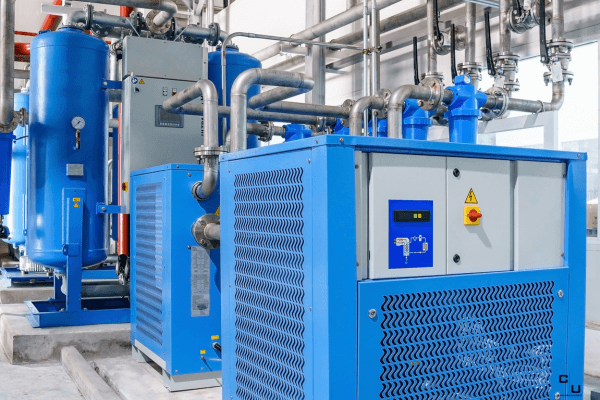
Meeting commercial HVAC energy efficiency standards requires more than choosing the right compressor. Learn how proper compressor selection, operating conditions, system performance, and evolving HVAC energy regulations can affect efficiency, industrial power consumption, and long-term operating costs.
Energy efficiency has become a major consideration in commercial HVAC and refrigeration. Facility managers are watching utility costs more closely, contractors are being asked to improve system performance, and building owners must account for evolving energy codes and equipment standards.
It’s important to note that the compressor sits at the center of that conversation.
In many commercial HVAC/R systems, compressors represent a significant portion of the electricity required for cooling. A compressor operating outside its intended conditions can consume more power while delivering less useful cooling. Across a large commercial or industrial system operating thousands of hours each year, that inefficiency can become a substantial operating expense.
Meeting modern compressor efficiency standards requires more than choosing an efficient compressor. Contractors and facility managers need to understand how the compressor interacts with the complete system, how HVAC energy regulations affect equipment decisions, and what can be done to control industrial power consumption.
Are There Energy Efficiency Standards for Commercial HVAC/R Compressors?
There is an important distinction between compressor efficiency and equipment efficiency.
In the United States, federal energy conservation requirements often apply to complete categories of commercial HVAC/R equipment rather than establishing one universal efficiency requirement for every standalone replacement compressor.
The U.S. Department of Energy regulates several categories of commercial HVAC equipment under 10 CFR Part 431. For applicable commercial unitary air conditioners and heat pumps, DOE uses efficiency metrics that include Integrated Energy Efficiency Ratio, or IEER, and Coefficient of Performance, or COP.
DOE has also established amended standards for certain air-cooled commercial package air conditioners and heat pumps with capacities of at least 65,000 Btu/h, with a compliance date of January 1, 2029.
For contractors, this means compressor replacement should not be viewed as simply matching horsepower or finding a compressor that physically fits. The compressor must support the designed performance of the complete HVAC or refrigeration system.
How Does ASHRAE 90.1 Affect Commercial HVAC Efficiency?
ANSI/ASHRAE/IES Standard 90.1 is another important reference for commercial building efficiency.
ASHRAE 90.1 establishes minimum energy-efficiency requirements for most commercial buildings and their systems. It is widely used as a benchmark for commercial building energy codes.
However, publication of a new ASHRAE standard does not mean every state or local jurisdiction immediately adopts it. Contractors, engineers, and facility managers should verify which requirements are currently enforced by the authority having jurisdiction.
For compressor replacement projects, the key point is that energy performance must be evaluated as part of the complete HVAC/R system.
Why Compressor Performance Affects Industrial Power Consumption
The compressor raises refrigerant vapor from suction pressure to discharge pressure. The harder it must work to accomplish that task, the more electricity the system can require.
Conditions that can increase compressor workload include:
- Excessive condensing pressure
- Low suction pressure
- Incorrect refrigerant charge
- Poor condenser or evaporator heat transfer
- Improper compressor sizing
- High compression ratios
- Worn internal components
- Electrical problems
- Improper capacity control
A compressor can still run while consuming more electricity than necessary.
This is why industrial power consumption cannot be evaluated by looking at the compressor alone. Contractors need to determine whether the refrigeration circuit and related equipment allow the compressor to operate within its intended range.
Correct Compressor Selection Is the Starting Point
Meeting efficiency goals begins before the replacement compressor is installed.
The compressor should be matched to the system's actual:
- Cooling capacity
- Refrigerant
- Suction and discharge conditions
- Voltage and phase
- Application temperature
- System configuration
Compressors Unlimited specializes in commercial HVAC and refrigeration compressors from 7.5 to 200 tons, including major brands such as Carrier, Copeland, Trane, and York.
Correct sizing is especially important.
An undersized compressor may operate for extended periods while struggling to satisfy demand. An improperly oversized compressor can contribute to cycling and control problems.
The objective is not to install the biggest compressor possible. It is to select the correct compressor for the application.
Operating Conditions Can Make or Break Compressor Efficiency
Even a properly selected compressor can consume excessive power when system conditions are poor.
Consider high head pressure. The compressor must work harder to move refrigerant against the elevated discharge pressure.
Common causes include:
- Dirty condenser coils
- Restricted airflow
- Condenser fan failures
- Improper water flow in water-cooled equipment
- Non-condensables
- Incorrect refrigerant charge
Low suction pressure can also increase the compression ratio. Refrigerant restrictions, evaporator airflow problems, low loads, and incorrect charge can all contribute.
When commercial compressor energy consumption increases, technicians should evaluate operating conditions before assuming the compressor itself is inefficient.
Measure Performance Instead of Guessing
Facility managers interested in reducing HVAC power consumption should establish baseline operating data.
Useful information includes:
- Compressor amperage
- Suction pressure
- Discharge pressure
- Suction temperature
- Discharge temperature
- Runtime
- Cycling frequency
- Cooling load
- Energy consumption
One reading rarely tells the entire story. Trends are much more valuable.
If a compressor begins drawing more amperage while handling approximately the same load, investigate why.
Internal compressor wear could be responsible, but the problem could also involve heat transfer, controls, refrigerant conditions, or system load.
Monitoring performance allows facility managers to address inefficient operation before it develops into an expensive compressor failure.
Part-Load Efficiency Matters
Commercial HVAC/R systems do not operate at full design load every hour.
Outdoor temperatures change. Building occupancy varies. Refrigeration loads fluctuate. Operating schedules change throughout the week.
Part-load performance is therefore important when considering overall HVAC/R efficiency.
DOE's use of IEER for applicable commercial equipment reflects the importance of evaluating performance at multiple operating conditions rather than looking exclusively at peak-load efficiency.
Technicians should also pay attention to:
- Compressor staging
- Capacity control
- Unloading
- Cycling frequency
- Control sequences
Poor capacity control can waste electricity and place unnecessary mechanical and electrical stress on compressors.
Can Remanufactured Compressors Help Meet Efficiency Goals?
Facility managers sometimes assume improving efficiency automatically requires buying a brand-new compressor or replacing the entire system.
That is not necessarily true.
When the existing HVAC or refrigeration equipment remains viable, a properly remanufactured compressor can provide a cost-effective way to restore compressor performance without replacing the complete system.
Compressors Unlimited's remanufacturing process includes complete disassembly and inspection, replacement of critical wear components, leak testing, and run testing. During testing, operating characteristics including oil pressure, amperage, loading, unloading, and pump-down capability are checked.
These steps matter because excessive internal wear and improper mechanical tolerances can reduce performance and contribute to unnecessary energy consumption.
Extending Existing Equipment Investments
Efficiency improvements do not always require complete equipment replacement.
If a commercial rooftop system, chiller, refrigeration rack, or other HVAC/R system remains viable, replacing a failed compressor can preserve a significant portion of the existing equipment investment.
Remanufacturing can be particularly useful when:
- An OEM compressor has a long lead time
- A legacy compressor model is difficult to source
- Complete system replacement requires substantial capital
- Existing piping and controls remain serviceable
- Downtime must be minimized
For Carrier and Carlyle applications, contractors can also review the Compressors Unlimited guide to available remanufactured compressor options.
Refrigerant Selection Also Influences Compressor Performance
Compressor efficiency cannot be separated from the refrigerant being used.
Different refrigerants have different:
- Pressure-temperature relationships
- Mass flow characteristics
- Discharge temperatures
- Lubricant requirements
- Capacity characteristics
If a facility is considering a refrigerant conversion during compressor replacement, the complete application should be evaluated.
Compressors Unlimited normally ships compressors with mineral oil or POE oil based on the known application for that specific compressor model. However, detailed refrigerant information is not always available when an order is placed.
The contractor determines the refrigerant and is responsible for confirming compatibility between the refrigerant and oil.
Some compressors may also ship without an oil charge. Compressors Unlimited drains the oil after testing when necessary. Compressors shipped by air or ocean freight cannot be shipped with an oil charge.
These details should be addressed before startup, since improper lubrication can affect compressor reliability and performance.
Installation Quality Directly Affects Energy Efficiency
A correctly selected compressor can still perform poorly after an improper installation.
Before startup, technicians should verify:
- Proper system evacuation
- Appropriate filter-drier strategy
- Correct refrigerant charge
- Proper oil type and level
- Balanced electrical voltage
- Adequate condenser and evaporator heat transfer
- Proper control and safety operation
A compressor operating under poor system conditions may consume more electricity and face a greater risk of premature failure.
Efficiency is the result of compressor condition, correct selection, quality installation, and proper system operation working together.
How Can Facilities Reduce Commercial Compressor Energy Consumption?
For facility managers asking how to reduce commercial HVAC or refrigeration power consumption, the process should begin with measurement rather than replacement.
A practical approach is to:
- Establish normal compressor amperage and operating pressures.
- Compare power use with actual system load.
- Investigate abnormal suction or discharge conditions.
- Correct condenser and evaporator heat-transfer problems.
- Verify refrigerant charge.
- Evaluate compressor cycling and capacity controls.
- Investigate increasing power consumption before failure occurs.
- Replace a worn compressor when repair is no longer practical.
- Confirm that replacement equipment supports the system's efficiency requirements.
This approach can prevent facilities from replacing expensive equipment when the real efficiency problem exists elsewhere in the system.
Frequently Asked Questions About Compressor Efficiency Standards
What are commercial compressor efficiency standards?
There is no single federal efficiency standard that applies identically to every standalone commercial compressor. DOE regulates various categories of commercial HVAC equipment, while standards such as ASHRAE 90.1 establish broader requirements affecting commercial buildings and equipment.
What does IEER mean in commercial HVAC?
IEER stands for Integrated Energy Efficiency Ratio. It represents cooling efficiency across multiple operating conditions for applicable commercial HVAC equipment, helping account for part-load operation.
Can a remanufactured compressor operate efficiently?
Yes. A properly remanufactured compressor can restore the mechanical condition and performance expected from that model. Actual system efficiency still depends on correct sizing, refrigerant conditions, heat transfer, controls, installation, and system operation.
How can facilities reduce industrial compressor power consumption?
Monitor amperage, pressures, temperatures, runtime, and system load. Conditions such as high head pressure, low suction pressure, incorrect refrigerant charge, poor heat transfer, improper sizing, and excessive cycling can all increase compressor workload.
Does replacing a compressor automatically make an HVAC system compliant with current energy codes?
No. Energy regulations generally apply to complete equipment or building systems. Replacing a compressor alone does not automatically establish compliance with current energy codes.
Make Efficiency Part of Every Compressor Replacement Decision
Energy efficiency requirements will continue to evolve, but the fundamental principles of efficient compressor operation remain consistent.
The compressor needs to be properly sized, correctly installed, operated within its intended conditions, and supported by a healthy HVAC or refrigeration system.
When considering a replacement, contractors and facility managers should ask:
- Does the compressor match the current load?
- Is it appropriate for the refrigerant and application?
- Is the system causing unnecessary compressor workload?
- Are capacity controls functioning correctly?
- Can the existing equipment continue operating economically?
- Will the replacement support long-term energy and reliability goals?
When a commercial compressor needs replacement, the goal should be more than restoring cooling. A properly selected replacement should help restore reliable operation while allowing the HVAC or refrigeration system to perform as efficiently as its design permits.