
Understanding Compressor Nomenclature: What All Those Letters and Numbers Actually Mean
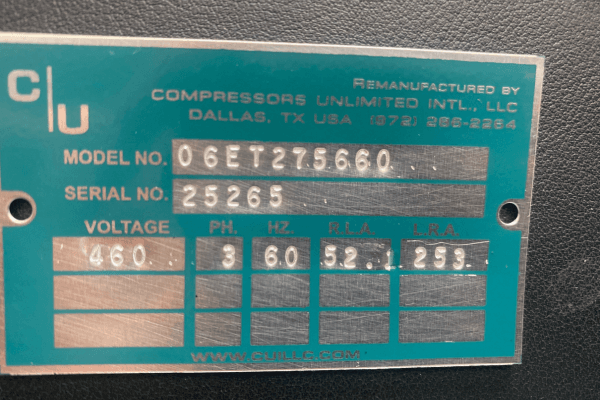
If you’ve ever looked at the nameplate of a commercial HVAC or refrigeration compressor, you know it can feel like trying to read a secret code. A string of letters and numbers, something like 06ET275610 or 3DS3R12METFC800, is stamped on the unit. To the untrained eye, it looks random, but every character in that model number serves a purpose.
This alphanumeric code is called compressor nomenclature, and learning how to read it can save you time, money, and a lot of frustration when sourcing a replacement. Here’s a breakdown of what those letters and numbers really mean, and how you can use them to identify the right compressor for your system.
Why Compressor Nomenclature Matters
Model numbers aren’t just identification tags. They provide specific details about a compressor’s:
- Series or family
- Cylinder count or displacement
- Refrigerant compatibility
- Electrical configuration (voltage and phase)
- Mounting and accessory features
When you understand compressor nomenclature, you can quickly match a failed unit with the correct replacement, avoid ordering errors, and ensure the new or remanufactured compressor is 100% compatible with your system.
Carrier Nomenclature Example: 06ET275610
Carrier compressors, especially the 06D and 06E semi-hermetic models, are widely used in commercial applications. Let’s decode a typical Carrier model number.
06ET275610
- 06E: Series (semi-hermetic, 6-cylinder design)
- T: Refrigerant designation or specific model variant
- 275: Capacity or displacement code (expressed in BTUs per hour or a related metric)
- 610: Voltage, phase, and motor code
So, when you see 06ET275610, you know you’re dealing with a six-cylinder 06E series compressor designed for a specific refrigerant, delivering a certain capacity, and set up for a defined electrical configuration.
Copeland Nomenclature Example: 3DS3R12METFC800
Copeland compressors use a slightly different approach to nomenclature. Here’s how to break down this model:
3DS3R12METFC800
- 3D: Compressor series (semi-hermetic)
- S3: Size and displacement designation
- R12: Refrigerant originally intended (R-12 in this case, but often retrofit-compatible)
- M: Motor code
- E: Electrical specification (voltage, phase, frequency)
- TFC: Terminal type and configuration
- 800: Additional configuration or feature code
This detailed code tells you not only the size and refrigerant but also the electrical and physical setup of the compressor. That’s why technicians rely on the model number to avoid mismatches that could lead to poor performance or system incompatibility.
Common Mistakes When Reading Compressor Model Numbers
Even experienced technicians sometimes misinterpret compressor nomenclature. Here are common pitfalls to avoid:
- Confusing serial numbers with model numbers: The serial number is unique to one unit, but it won’t tell you technical details. Always look for the model number.
- Assuming the refrigerant code is the only thing that matters: A compressor might have originally been built for R-22, but a remanufactured version could be configured for R-407C or R-448A.
- Ignoring electrical configuration: A mismatch in voltage or phase can prevent installation entirely.
- Guessing instead of confirming: When in doubt, work with a remanufacturer, like us, who can interpret model numbers and cross-reference legacy codes.
Why Remanufacturing Keeps Nomenclature Relevant
Remanufacturing allows older compressors with obsolete refrigerants or electrical setups to be rebuilt for modern requirements. At Compressors Unlimited, we use model numbers as the foundation for matching, then configure the rebuild for current refrigerants, oils, and performance needs.
For example:
- A Carrier 06D originally designed for R-22 can be remanufactured to run on R-407C or R-448A.
- A Copeland semi-hermetic originally configured for R-404A can be rebuilt for R-449A.
The model number gives the roadmap, but the remanufacturing process ensures compliance with today’s standards.
How to Use Nomenclature When Ordering Replacements
When you’re sourcing a compressor replacement:
- Locate the model number on the nameplate or system documentation.
- Write it down exactly; even one digit off can result in the wrong unit.
- Provide it to your supplier or remanufacturer so they can cross-reference it.
- Confirm refrigerant and oil compatibility for your specific application.
- Verify electrical specs match your system’s requirements.
At Compressors Unlimited, we handle this process daily. Customers send us model numbers, and we decode them to deliver the right compressor, remanufactured, tested, and backed by a limited warranty.
Your Next Step - Order Your Compressor Replacement
Compressor nomenclature might look confusing at first glance, but it’s one of the most valuable tools in keeping commercial HVAC/R systems running smoothly. Every letter and number has a purpose, and once you know how to read them, identifying the right replacement becomes a much simpler process.
Whether you’re working with Carrier, Copeland, Trane, or Bitzer compressors, Compressors Unlimited can help interpret your model number and ensure you get the exact match your system requires.
If you’re staring at a worn nameplate or dealing with an obsolete code, send it our way. We’ll help you decode it, match your replacement, and keep your system running without unnecessary downtime.